
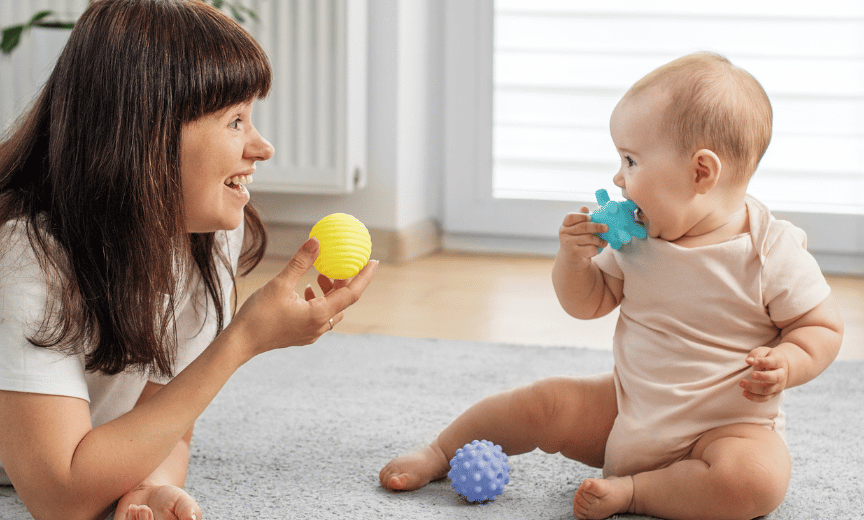
How Babies Communicate Before Talking: Watch, Pause & Respond
Your baby reaches toward a toy. Looks at you. Looks back at the toy. Makes a sound. Leans forward.
No words yet—but they are communicating.
Communicating with a preverbal baby is a careful dance of noticing, listening, and responding. It means learning to hear with your eyes as much as your ears.

You have done it subconsciously since day one. Baby starts suckling you know its time to feed them, they cry, its time to change them. How we respond to our baby’s early communication cues supports connection, learning and early language development.
Learning to notice these preverbal signals can help parents respond, build connection and support early communication development.
Before babies can talk, their eyes, faces, bodies, sounds, and movements are already part of the conversation.
Communication Starts Before Words
As your baby grows, their early communication skills expand. Long before talking, babies communicate through eye gaze, facial expressions, reaching, body movements, gestures and sounds. It’s all more subtle than before. As they become more mobile they may make gestures, repeat actions, move towards something and vocalize or babble. A small response that is easier to over look. Babies have a rich collection of preverbal communication cues long before they say their first words.
But it is up to us to notice the subtle communication, pause to “hear” its full meaning, and respond appropriately.

What Does “More” Look Like? Baby Communication Cues to Watch For
What “MORE” Looks Like Before Words
- Reach toward the toy
- Lean closer
- Smile or become more animated
- Kick or bounce
- Vocalize
- Look from the toy to you and back again
- Crawl toward it
- Try an action again
When you see these cues narrate for your child. “You are reaching for the toy again. Do you want more?” Support the conversation by using the sign for more as you say it. The narration and the sign gives language to communication that is already happening. This acknowledges your baby’s desires and reinforces the communication attempts. This exchanges exposes your child to new forms of communication encouraging their language development.

Baby Communication Cues: What Is My Baby Trying To Tell Me?
Let’s say there is a toy with bright lights and loud songs playing. This can be overstimulating. How do you know when your baby has had enough? The most common signal might be fussing or crying or pushing the toy away. Turning their head or body away from the lights, looking away, arching their back or moving away are common responses to over stimulation. But if they become very still, slow down their responses or seem to lose interest they may be telling you they are all done as well. Narrating their overstimulating responses and offering an “all done” with a sign strengthens trust and communication with your baby.
A look away doesn’t always mean “I’m done.”
Sometimes babies briefly look away to regulate themselves, process what just happened, or take a sensory break before coming back.
There may be something else happening as well. Sometimes when a baby looks away, they are self-soothing. A look away may provide the short sensory break they need, a moment to process what just happened, or a break to notice something else. They may then turn back and reengage with the toy once their need for a break has been satisfied.
The Power of the Pause in Early Communication
So how do we hear what they are telling us without hearing a word? We watch. And to watch effectively we must slow down. We must pause. In that pause we wait and observe what happens next. Take that extra beat or two to see what further communication or response your baby is having. Is he all done? If you respond too quickly you do not give him the chance to just take a break and reengage. So the pause becomes crucial.
As parents we naturally want to fix every problem that comes along. Hand over the toy they can’t reach, show them how it works or repeat a favorable activity immediately. We rush to problem solve often trying to make a preemptive strike to ward off any kind of “negative” reaction from our baby. But there is power in the pause.

Just a few seconds of waiting can give babies time to assess the situation, plan a move or problem solve. They may initiate further communication, reach, vocalize, try again or decide if they are all done.
Sometimes we miss our baby’s turn because we’re already busy taking the next one for ourselves.
Follow Your Baby’s Lead During Play
As grownups we often approach play with an idea of the right way to do it. It’s obvious to us- This is a ball, we roll it. This is a book, we read it. You touch this green button to make the trap door open.

But our baby might explore a toy completely differently. They are a few steps back in the evolution of understanding. Therefore, they may take the ball and bang it, mouth it, hold it, crawl over it, follow it. Once they learn it doesn’t taste good, doesn’t make a great sound, is boring to hold and awkward to climb over, then rolling the ball becomes more meaningful and entertaining. Development happens through exploration, not through doing an activity the “right” way. So try following your baby’s lead. Ask yourself, “what is my baby interested in doing with this?” rather than “How do I get my baby to do this the right way.”
Just a few seconds of waiting can give babies time to assess the situation, plan a move or problem solve.
Make the pause meaningful. If your baby has a ball and it rolls out of reach, pause. See what happens. Baby may look at it, reach for it, vocalize about it. Communication is happening. They may look at you (an opportunity to narrate what has happened) shift positions and begin moving towards it (now they are problem solving). The pause becomes a powerful developmental tool!
Turn Communication Into Conversation
Turn their early communication into a conversation. Creating situations where a back-and-forth conversation happens and deepens the communication. These early communication moments are also a natural place to introduce baby sign language. Instead of asking a baby to perform a sign, parents can pair a simple sign with the communication already happening—such as signing MORE when a baby reaches for another turn or ALL DONE when they signal they need a break.
You take a turn and roll the ball to them. Their response may be a squeal or grab or they may pat the ball. Pause and see what they do next. In the pause you can narrate what you see them doing giving them words for what they experience. “The ball is squishy.” When they continue to engage, touching the ball again, you can insert a sign into the conversation. “More?” (while you vocalize and sign the word) “Do you want more?” A smile, a lean or a grab will give you their answer.

Baby signs are most meaningful when they are layered onto the communication your baby is already using.
Pairing baby sign language with spoken words, gestures and everyday interactions gives your baby another way to participate in the conversation.
You have “played” with the ball. It may look different than rolling it back and forth but you have had a conversation and their understanding of the ball has deepened.
Try This at Home: Practice Reading Your Baby’s Communication Cues
Choose one everyday activity: floor play, bath time, feeding, book time, bubbles, or getting dressed.
- Watch before directing.
- Notice one thing your baby seems interested in.
- Pause when they make a sound, gesture, reach, or movement.
- Wait to see what happens next.
- Respond to what they do.
- Add simple words or signs to their communication.
What did your baby tell you that you might normally have missed?
Conclusion
Responding to early communication isn’t about perfectly decoding every look, sound, or movement. It’s about getting curious. What might your baby be noticing? What are they trying to tell you? What happens when you pause and respond?
You don’t need to do this all day long. Just look for little moments when you can slow down, follow your baby’s lead, and enjoy the back-and-forth together. Long before first words, babies already have so much to say—and it can be pretty amazing to discover what they’re telling us.

In Sensory & Sign Playtime, we practice noticing these early communication cues while babies explore movement, sensory play, music, and baby sign in a developmentally supportive environment.